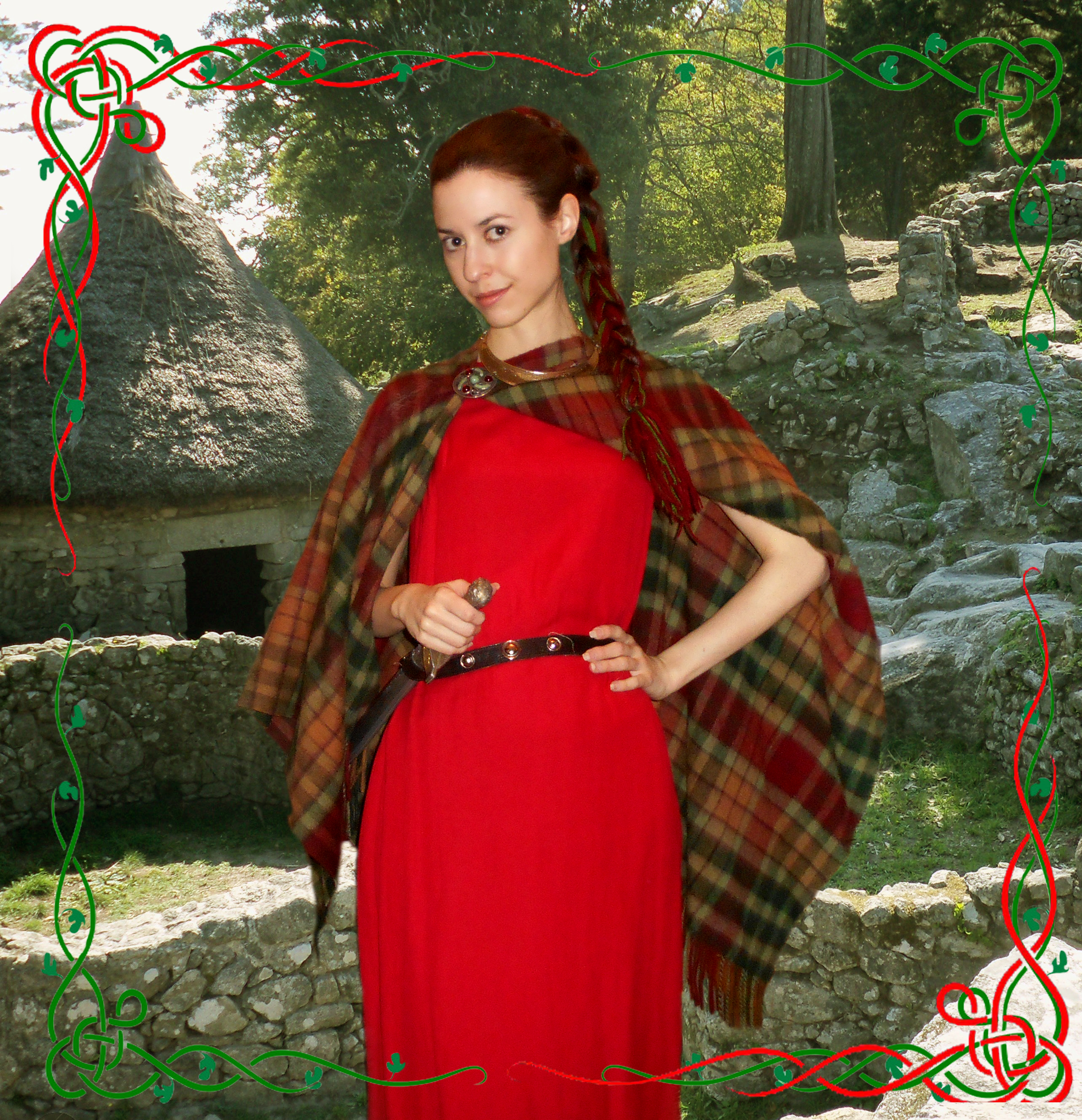
During the May 2019 EstelCon, the annual convention of the Spanish Tolkien Society, I wore one of my hair staples for more than a year, Janet Stephens' knotted Valkyrie ponytail, with a casual ranger look (aka Merida's kirtle and cloak xD):
Janet Stephens' video of this style:
SwordWomanRiona / rionashairblog.blogspot.com.es
If you copy-and-paste this post and/or alter it without any
permission, credit or link, you're stealing my content. In that case,
please stop. Please ask before using my work, or at least share it
properly, giving credit to me and my blog.
I've been wearing more French braids recently, and I had missed how comfy they are :)! So here's a paranda French braid with a flexi 8 from an August outing:
SwordWomanRiona / rionashairblog.blogspot.com.es
If you copy-and-paste this post and/or alter it without any
permission, credit or link, you're stealing my content. In that case,
please stop. Please ask before using my work, or at least share it
properly, giving credit to me and my blog.
Today's hairstyle tutorial is a braided variation of the knotted 'Valkyrie Ponytail', which I learnt thanks to Janet Stephens' video:
This length-shortening updo/half-up is pretty easy and fast to do and very comfortable to wear. It's great for when you don't want to wear all your hair up, but also want to keep it a bit contained. Also, the knot tends to keep the dangling braid hanging a bit further away from the neck and shoulder area, and thus prevents it from getting stuck in stuff more easily. I've been wearing both the standard Valkyrie ponytail and my braided variation (either three-strand or rope-braid) as a weekly staple for nearly a year now :D. Recorded tutorials will be coming soon, but in the meantime here are some written instructions as usual :)
These pics are from an August outing and feature my red and green paranda . This ensemble always kinda reminds me of a Roman
priestess for some reason 😃 xD
For this style I used:
-Comb and/or brush as needed.
-A metal-free elastic for the initial ponytail -Paranda for the braid
-Hairstick
-Open pins for final touches
Steps:
-Pull the hair into a high ponytail - mid-height is my preference.
-Braid the ponytail, with a paranda for added volume (tutorial here). It can be a three-strand braid, or a rope-braid, for ex.
-Now comes the knot - Same as described in the video above, but with the braid. The knot is enough to hold the hair in many cases, but I prefer to further secure the style using a hairstick. This also looks nice, and ensures that the hanging braid stays out of the way in a comfortable way.
-I use a couple of open bun pics to polish some flyaways at the nape.
-Add aloe vera gel or hairspray to set the style and potential flyaways (if you want), and it's done!
✨Pic gallery of this style:
Tolkien ranger OC cosplay (2018):
Celtic sword-woman casual reenactment (2019):
Medieval-inspired outfit with Merida's kirtle and cloak (2025-26):
SwordWomanRiona / rionashairblog.blogspot.com.es
If you copy-and-paste this post and/or alter it without any
permission, credit or link, you're stealing my content. In that case,
please stop. Please ask before using my work, or at least share it
properly, giving credit to me and my blog.
Cosplay hair pic spam today :D! For the first day at a Tolkien convention last May I wore my Elven purple dress with a parada braid (just a simple three-strand braid with a paranda). I also debuted a late 14th Century-early 15th Century reenactment, so I gave this cosplay a 14th Century twist with the liripipe open hood that I quite like :D (the dress, while not historically accurate, gives me 14th Century vibes as well because it reminds me of the long-sleeved cottehardies).
So, braid pics incoming!
SwordWomanRiona / rionashairblog.blogspot.com.es
If you copy-and-paste this post and/or alter it without any
permission, credit or link, you're stealing my content. In that case,
please stop. Please ask before using my work, or at least share it
properly, giving credit to me and my blog.
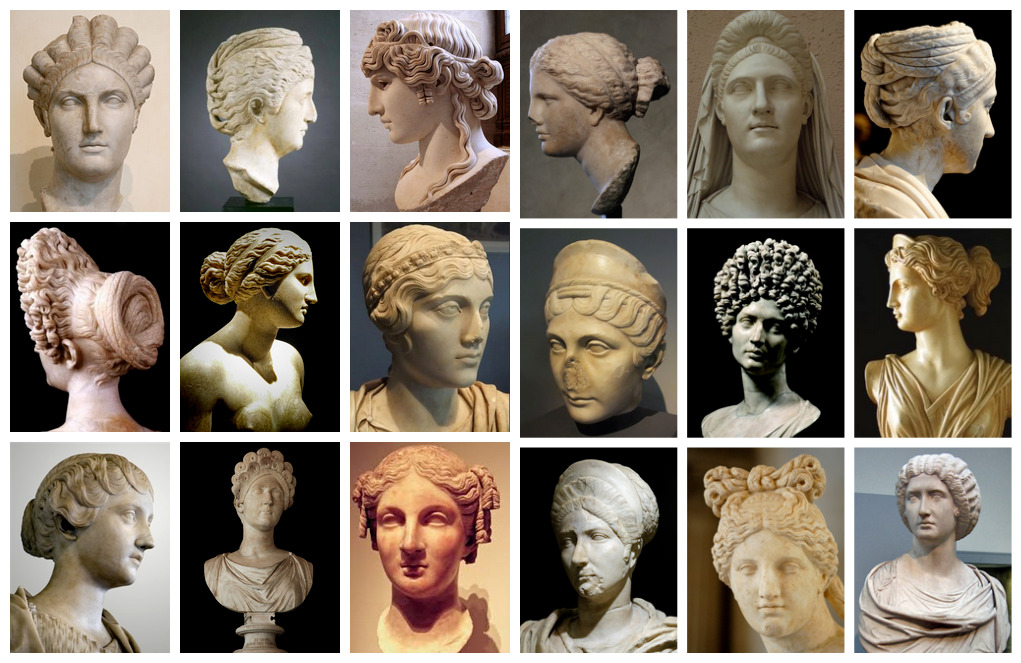
During my last Summer London trip I visited The Museum of London, and there was a whole section devoted
to Ancient
Roman female hairstyling, make-up and dressing, so finally getting some
content back on this blog with some historical hairstyling and haircare (I also
talked from a feminist lens about modesty
mindsets in Ancient Roman female fashion, in this case regarding veiling
with the palla, in the latest post of my
other blog, where I talk about feminism, history and fandoms).
"Hair
was seen as much as an indication of wealth and social status as it was of
taste and fashion. But unlike modern-day hairstyles, comfort and naturalism for
the Romans took a back-seat to hairstyles that displayed the wearer's wealth to
a maximum. In other words, having a complex and unnatural hairstyle would be
preferred to a simple one, because it would illustrate the wealth of the wearer
in being able to afford to take the time to style their hair.For
women to have a fashionable hairstyle showed they were part of the elegant
Roman culture." (Source)
"Hairnets
and pins were in common usage (...). Poorer women would have used wooden pins,
while the aristocracy used gold, ivory, crystal, silver or painted bone. The
pins were decorated with carvings of the gods, or beads and pendants"
(Source)
“For keeping the hair in place pins
were used, of ivory, silver, and gold, often mounted with jewels.
Some wealthy Roman women favored long hairpins encrusted with jewels.
(...) Nets (reticulae) and ribbons (vittae, taeniae,
fasciolae) were also worn, but combs were not made a part of the
headdress. (...) Mention should also be made of the garlands (coronae)
of flowers, or of flowers and foliage, and of the coronets of
pearls and other precious stones that were used to supplement the natural
or artificial beauty of the hair. The woman's hairdresser was a female
slave. This ornatrix was an adept in all the tricks of the toilet
(...), and, besides, used all sorts of unguents, oils, and tonics to
make the hair soft and lustrous and to cause it to grow abundantly. Common
toilet articles including hairpins, hand mirrors made of highly polished metal,
combs, and boxes for unguent or powder." (Source)
"Roman women originally dressed their hair with great
simplicity. One of the simplest styles of wearing the hair was allowing it
to fall down in tresses behind, and only confining it by a band encircling the
head. Another favourite but simple hairstyle was braiding the hair, and
then fastening it behind with a large pin. Young girls wore their long
hair in simple buns tied at the base of the neck or wore their hair in a top
knot. Simple hairstyles for married women changed during the reign of
the Emperor Augustus when a variety of different and elaborate hairstyles came
into fashion. The clothing fashions of Roman women remained relatively simple
and unchanging and as women had no special dress that distinguished their
status the wealthy women wore luxurious materials, highly elaborate
hairstyles, make-up and expensive jewelry. During the rule of the Flavian
emperors (69-138 BC) hairstyles were raised to a great height by rows of
false curls. This fashion was described by the writer Juvenal as the
hairstyles made women appear tall from the front but quite the opposite from
the back. The hair of Roman women become elaborately curled. Hairstyles
were elaborately arranged in layers. Hairstyles involved hair being twisted,
waved and curled. Ringlets were created to create hairstyles which fell to the
sides and the backs of the head. Wigs and hair pieces were used to create an
illusion of abundant locks." (Source)
I like Roman hairstyles a lot, so thanks to Janet Stephens' tutorials, hopefully I'll find some spare time sometime to try out some of them and post more about historical hair in this blog :D!





.JPG)
.JPG)


.JPG)