During my last Summer London trip I visited The Museum of London, and there was a whole section devoted
to Ancient
Roman female hairstyling, make-up and dressing, so finally getting some
content back on this blog with some historical hairstyling and haircare (I also
talked from a feminist lens about modesty
mindsets in Ancient Roman female fashion, in this case regarding veiling
with the palla, in the latest post of my
other blog, where I talk about feminism, history and fandoms).
"Hair was seen as much as an indication of wealth and social status as it was of taste and fashion. But unlike modern-day hairstyles, comfort and naturalism for the Romans took a back-seat to hairstyles that displayed the wearer's wealth to a maximum. In other words, having a complex and unnatural hairstyle would be preferred to a simple one, because it would illustrate the wealth of the wearer in being able to afford to take the time to style their hair. For women to have a fashionable hairstyle showed they were part of the elegant Roman culture." (Source)

"Hairnets
and pins were in common usage (...). Poorer women would have used wooden pins,
while the aristocracy used gold, ivory, crystal, silver or painted bone. The
pins were decorated with carvings of the gods, or beads and pendants"
(Source)

“For keeping the hair in place pins
were used, of ivory, silver, and gold, often mounted with jewels.
Some wealthy Roman women favored long hairpins encrusted with jewels.
(...) Nets (reticulae) and ribbons (vittae, taeniae,
fasciolae) were also worn, but combs were not made a part of the
headdress. (...) Mention should also be made of the garlands (coronae)
of flowers, or of flowers and foliage, and of the coronets of
pearls and other precious stones that were used to supplement the natural
or artificial beauty of the hair. The woman's hairdresser was a female
slave. This ornatrix was an adept in all the tricks of the toilet
(...), and, besides, used all sorts of unguents, oils, and tonics to
make the hair soft and lustrous and to cause it to grow abundantly. Common
toilet articles including hairpins, hand mirrors made of highly polished metal,
combs, and boxes for unguent or powder." (Source)

"Roman women originally dressed their hair with great
simplicity. One of the simplest styles of wearing the hair was allowing it
to fall down in tresses behind, and only confining it by a band encircling the
head. Another favourite but simple hairstyle was braiding the hair, and
then fastening it behind with a large pin. Young girls wore their long
hair in simple buns tied at the base of the neck or wore their hair in a top
knot. Simple hairstyles for married women changed during the reign of
the Emperor Augustus when a variety of different and elaborate hairstyles came
into fashion. The clothing fashions of Roman women remained relatively simple
and unchanging and as women had no special dress that distinguished their
status the wealthy women wore luxurious materials, highly elaborate
hairstyles, make-up and expensive jewelry. During the rule of the Flavian
emperors (69-138 BC) hairstyles were raised to a great height by rows of
false curls. This fashion was described by the writer Juvenal as the
hairstyles made women appear tall from the front but quite the opposite from
the back. The hair of Roman women become elaborately curled. Hairstyles
were elaborately arranged in layers. Hairstyles involved hair being twisted,
waved and curled. Ringlets were created to create hairstyles which fell to the
sides and the backs of the head. Wigs and hair pieces were used to create an
illusion of abundant locks." (Source)
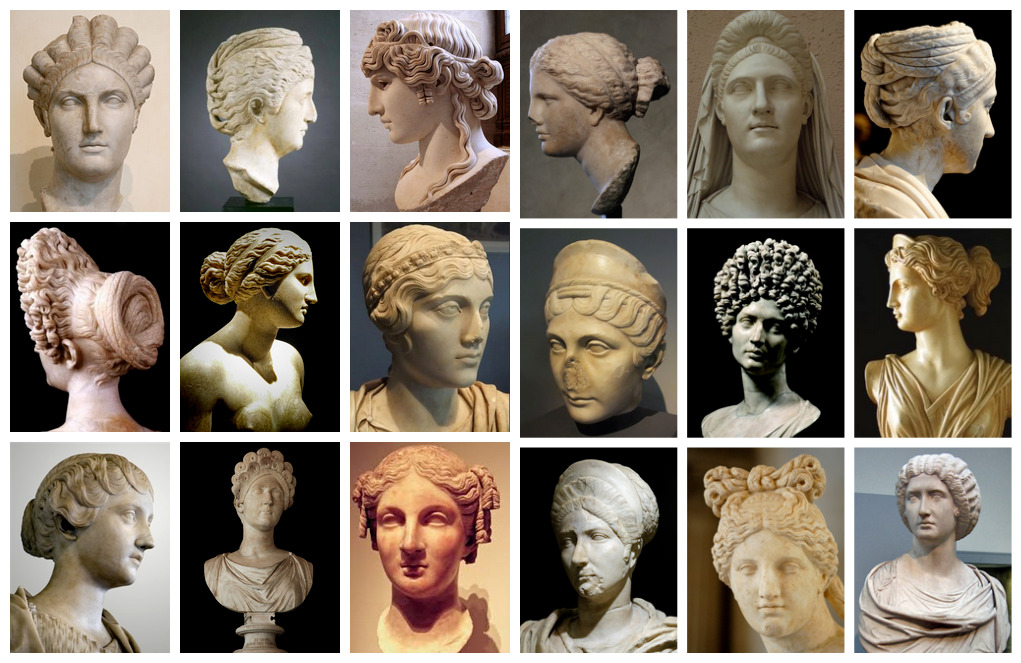
I like Roman hairstyles a lot, so thanks to Janet Stephens' tutorials, hopefully I'll find some spare time sometime to try out some of them and post more about historical hair in this blog :D!